Hacktivism: When Hacking Is Driven by a Cause
Hacktivism is cause-driven hacking. Its common tactics, how it differs from criminal and state activity, and how to defend against it.
Most cyber attacks are quiet by design. The attacker wants to stay in, take what they came for, and leave without a trace. Hacktivism inverts that logic. A hacktivist wants to be seen. The whole value of the operation is the attention it draws to a cause, so the attack is loud, claimed, and often announced in advance. Understanding that motivation is the key to reading the threat correctly.
Hacktivism, a blend of "hacking" and "activism", is the use of hacking techniques to advance a political, social, or ideological goal. The methods overlap with ordinary cybercrime, but the intent, and therefore the behaviour, is different. This guide covers what hacktivists actually do, how they differ from criminals and state actors, and how to defend against tactics that are chosen for visibility.
What defines hacktivism
The defining feature is motivation. A financially driven criminal measures success in money. A state actor measures it in intelligence gathered or strategic effect achieved. A hacktivist measures it in attention: did the message reach an audience, did the target look weak, did the cause gain traction.
That single difference shapes everything downstream. Because the goal is publicity, hacktivists claim their work, often loudly, on social media and in manifestos. They pick targets with symbolic weight: government sites, large corporations, organisations tied to a contested issue. And they favour tactics that produce a visible result quickly, because a disruption nobody notices is a failure by their own metric.
Hacktivism is usually decentralised. Movements form around a banner rather than a payroll, participants come and go, and skill levels vary widely. A single operation might mix a handful of capable operators with a large crowd running point-and-click tools they were handed. That structure makes movements resilient and unpredictable, and it makes attribution genuinely difficult.
The common tactics
Hacktivist operations reuse a small, reliable set of techniques. What they lack in novelty they make up for in visibility.
| Tactic | What it does | Why hacktivists like it |
|---|---|---|
| Defacement | Replaces a website's page with the attacker's message | Instantly public, hard to miss, humiliating for the target |
| DDoS | Floods a service with traffic until it goes offline | Simple to coordinate, disrupts operations, easy to claim |
| Doxxing | Publishes private information about individuals | Pressures and intimidates named targets |
| Hack-and-leak | Steals data and dumps it publicly | Frames the target as corrupt or negligent |
Defacement maps to Defacement (T1491) on MITRE ATT&CK. It is the digital equivalent of graffiti on a landmark: usually not deeply damaging, but embarrassing and immediate.
Distributed denial-of-service maps to Network Denial of Service (T1498). It knocks a service offline by overwhelming it, and it is the signature hacktivist move because it needs no persistent access and can be coordinated by a crowd.
Doxxing and hack-and-leak are the more harmful end. Exposing personal data or dumping internal documents can cause lasting damage to individuals and lasting reputational harm to organisations. A leak is the tactic most likely to produce consequences that outlive the news cycle.
How hacktivism differs from crime and state activity
It helps to place hacktivism against the other two broad motives, because the response to each is different.
Versus cybercrime. Criminals want money and want to keep operating, so they stay quiet and reuse access. Hacktivists spend their access on a public statement, often burning it in the process. A criminal hides the breach; a hacktivist advertises it.
Versus state activity. Nation-state operations prize stealth, persistence, and intelligence value, and they almost never claim their work. Hacktivists claim everything and rarely persist. Where a state actor will sit undetected in a network for months, a hacktivist tends to make a splash and move on. See What Is an APT and Nation-State Hacking Explained.
The complication is that these categories leak into each other. Some "hacktivist" groups are deniable fronts operated or encouraged by a state, which gets the disruption of an attack while keeping the plausible deniability of a grassroots movement. Others drift toward extortion, using the threat of a leak for profit. The label a group wears tells you less than its behaviour does.
A group's name and manifesto are marketing. What matters operationally is the tradecraft: the tactics, the infrastructure, and the timing. Our Threat Groups directory tracks actors by their observed behaviour, which is what lets you tell a genuine cause-driven crew from a state front wearing a hacktivist badge.
Notable movements at a conceptual level
Rather than a roll call of names and dates, it helps to recognise the recurring patterns. Hacktivism tends to surface in a few forms.
- Banner movements that anyone can join under a shared identity, where the name is a franchise rather than an organisation. Operations are announced, participants opt in, and the collective claims credit.
- Cause campaigns that spin up around a specific event or grievance, run a burst of defacements and DDoS, then dissolve when attention moves on.
- Geopolitically aligned crews that appear during conflicts, target the other side's infrastructure and media, and blur into state-adjacent activity.
The through-line is that hacktivism is reactive and event-driven. It flares in response to news, elections, conflicts, and controversies. That rhythm is a useful defensive signal: if your organisation becomes associated with a contested issue, your exposure to opportunistic hacktivist attention rises, and it is worth raising readiness before the attention arrives.
A closer look at each tactic
The four tactics in the table above deserve more than a one-line summary, because the defense for each is different and because the way hacktivists use them differs from how a criminal or a state actor would.
Defacement replaces the content a site serves with the attacker's message. Mechanically it requires write access to the web content: a compromised content-management login, an unpatched application that allows file upload or code execution, or a stolen deployment credential. The attacker rarely needs deep access. Reaching the layer that renders the homepage is enough. For a hacktivist the appeal is that the result is instant and public. A visitor who loads the site sees the message directly, and screenshots spread on social media within minutes. On MITRE ATT&CK this is Defacement (T1491), which distinguishes internal defacement, aimed at users inside an organization, from external defacement of a public site.
Distributed denial-of-service overwhelms a service with traffic until legitimate users cannot reach it. It maps to Network Denial of Service (T1498). The hacktivist appeal is coordination without persistence. A crowd can be pointed at a target with a shared tool or a booter service, no foothold is needed, and the outage is easy to observe and claim. The disruption is temporary by nature. When the flood stops, the service returns, which is why DDoS produces a news moment rather than lasting damage in most cases. The exception is when an outage lands during a critical window, such as an election result page or a payment deadline.
Doxxing publishes private information about named individuals: home addresses, phone numbers, family details, employer information. It is a pressure and intimidation tactic aimed at people rather than systems. The data is often assembled from breaches, public records, and social media rather than a single intrusion, which means doxxing does not always require hacking at all. When it follows a breach, the harm compounds, because the exposure is targeted and personal.
Hack-and-leak steals internal data and dumps it publicly to frame the target as corrupt, negligent, or hypocritical. It combines an intrusion with a publication strategy. The leak is usually timed for maximum effect and framed with a narrative, so the operation is as much about the story as the data. Of the four tactics this one produces the most durable consequences, because leaked documents keep circulating and can seed further reporting long after the initial dump.
DDoS from a hacktivist is a public statement meant to be seen and claimed. The same DDoS from a criminal crew is often cover for extortion or a distraction during a quieter intrusion. The technique on the wire looks identical. The motive is what tells you whether to expect a manifesto or a ransom note, and it shapes how you respond. This is why threat intelligence tracks actors by behavior and context, not by the raw technique alone.
How hacktivism evolved
Hacktivism is not new, and its shape has shifted with the tools available. In the early era, the barrier to entry was skill. Defacing a site or knocking it offline required someone who understood the systems, so operations were small and the participants were capable. The message was the point even then, but the crowd could not join in directly.
Two changes widened the field. The first was the arrival of point-and-click attack tools that let people with no technical background take part in a coordinated flood. Suddenly an operation could mobilize a crowd, and the size of the crowd became part of the statement. The second was social media, which gave movements a way to organize, announce targets, and broadcast results to an audience far larger than the attack itself reached. A defacement seen by a few hundred visitors could be screenshotted and shown to millions.
The more recent shift is the blurring of hacktivism with state activity. During geopolitical conflicts, groups appear that carry the banner and rhetoric of grassroots hacktivism while operating with resources, timing, and target selection that suggest coordination or encouragement from a state. The label became a useful disguise. A government gains the disruption of an attack and the deniability of a crowd. This is why current threat intelligence treats a hacktivist claim as a starting hypothesis to be tested against behavior, rather than a settled fact about who is responsible. The context in our Threat Groups directory exists precisely to separate observed tradecraft from the banner an operation flies under.
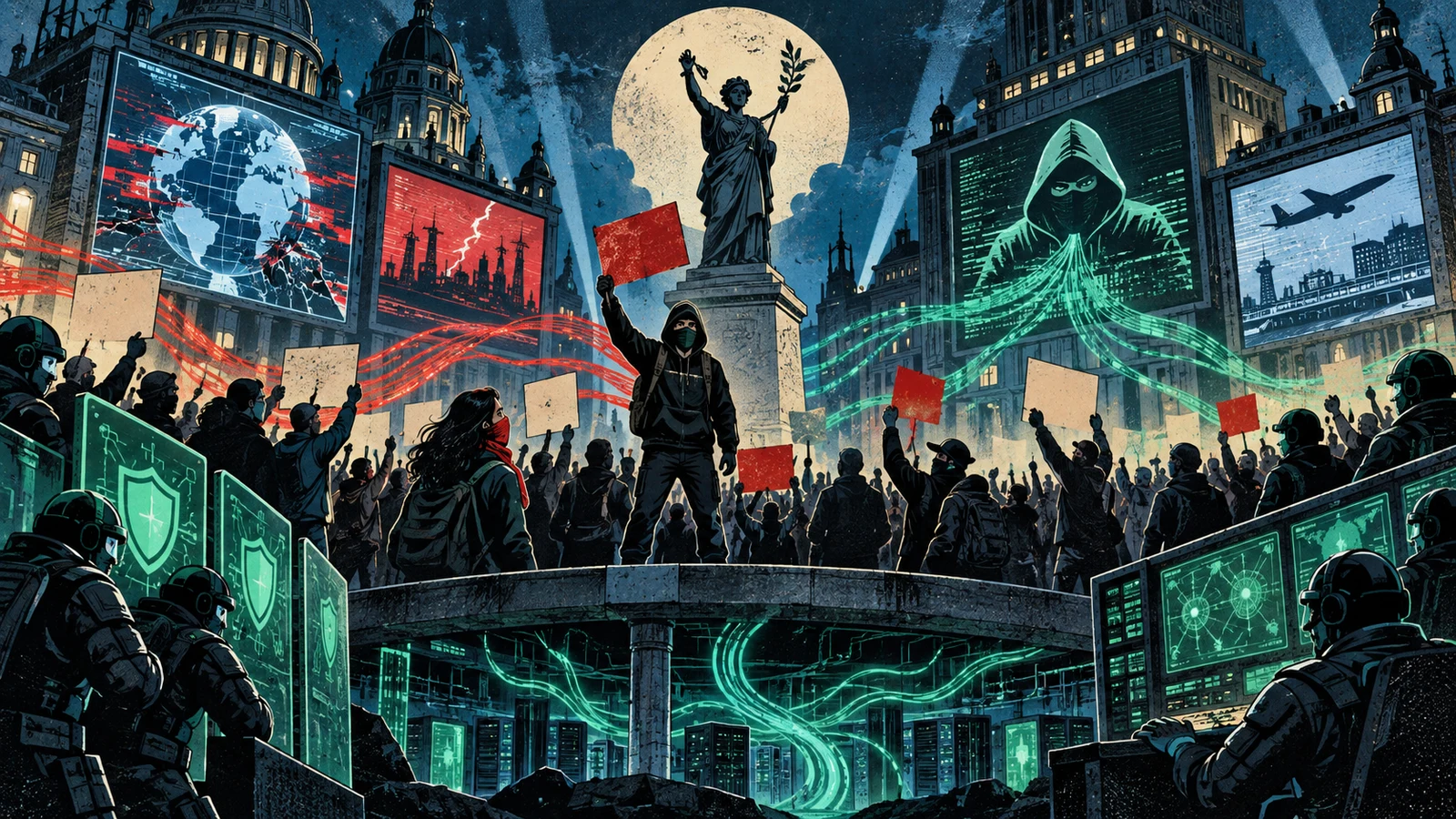
Reading the risk signals
Because hacktivism is reactive, an organization can often see its exposure rising before an attack lands. The triggers are usually public and predictable.
| Signal | Why it raises risk |
|---|---|
| Association with a contested political issue | Draws cause-driven attention from whichever side feels aggrieved |
| A prominent executive making public statements | Personalizes the target and invites doxxing |
| Operating in a country during a conflict | Attracts geopolitically aligned crews targeting the other side |
| A controversial product launch or policy change | Creates a grievance a movement can rally around |
| Being named in mainstream news on a divisive topic | Concentrates opportunistic attention during the news cycle |
None of these signals guarantees an attack, and none is a reason to change what an organization stands for. They are a scheduling input for the security team. When one of them appears, it is worth raising readiness: confirming DDoS protection is active, checking that public-facing applications are patched, and briefing the communications team that a public incident is more likely than usual. The rhythm of hacktivism is event-driven, so the calendar of likely triggers is often visible in advance.
A campaign from the outside in
Watching how a typical cause campaign unfolds makes the reactive rhythm concrete. The shape recurs even though the specifics change.
It begins with a trigger. A news event, a policy decision, a court ruling, or a corporate announcement generates anger among a group already inclined to act. Someone with a following frames the target and issues a call to action, naming an organization and a date. The framing does the recruiting. It gives a diffuse grievance a specific outlet.
Next comes mobilization. Participants gather on whatever platform the movement uses to coordinate, tools and target lists are shared, and the more capable operators quietly probe for the intrusions that will produce a leak or a defacement while the crowd prepares for the visible flood. This preparation phase is where a watchful defender can still see the storm forming, because target lists and calls to action are public by design.
Then the operation lands. The DDoS flood arrives at the announced time, defacements appear on any site that was reachable, and if a hack-and-leak was in progress, the stolen data is dumped with a narrative attached. Screenshots and claims spread immediately, because the spectacle is the product. The technical disruption may last minutes or hours, but the media moment is the real output.
Finally the campaign dissipates. Attention moves to the next event, participants drift away, and the banner goes quiet until the next trigger revives it. The infrastructure and the crowd do not persist, which is why hacktivism flares and fades rather than maintaining the steady presence of a criminal or state operation.
For a defender, the useful lesson is that most of this timeline is observable before the damage. The trigger is public, the call to action is public, and the target list is often public. Readiness raised during the mobilization phase, before the operation lands, is worth far more than a scramble once the flood is already underway.
Common misconceptions
Several assumptions about hacktivism lead defenders to prepare for the wrong thing.
The first is that hacktivism is always low skill. The crowd running point-and-click tools is real, but many movements include a core of capable operators who run the intrusions behind hack-and-leak operations. Treating every hacktivist as a script user underestimates the ones who can reach sensitive data. The visible flood is sometimes cover for a quieter, more skilled effort.
The second is that a claim of responsibility is proof. Claims are trivial to make and trivial to fake. A group may claim an attack it did not carry out to inflate its reputation, and a state actor may claim to be a hacktivist group to hide its hand. The claim is a data point to verify, not a conclusion.
The third is that the damage is only reputational. Defacement and DDoS are usually recoverable, which supports that impression, but doxxing and hack-and-leak can cause lasting harm to individuals and can expose data that fuels further attacks. Judging the whole category by its most transient tactic understates the risk from its most damaging one.
The fourth is that being uncontroversial makes an organization safe. Target selection is often opportunistic. A vulnerable public site can be defaced simply because it was easy, and used as a trophy, regardless of whether the organization has any connection to the cause. Weak security is itself a reason to be picked.
Frequently asked questions
Is hacktivism illegal?
The techniques hacktivists use, unauthorized access, defacement, denial of service, and publishing stolen data, are crimes in most jurisdictions regardless of the motive behind them. A political or social cause does not change the legal status of gaining unauthorized access to a system or knocking it offline. Practitioners sometimes frame their actions as civil disobedience, but that framing does not alter how the law treats the underlying acts.
How is hacktivism different from cyberterrorism?
The line is one of intent and severity. Hacktivism aims to draw attention, embarrass a target, or disrupt operations to make a point. Cyberterrorism aims to cause serious harm, fear, or physical consequences in pursuit of a political goal. Most hacktivist activity, defacement and DDoS in particular, is disruptive and reputational rather than physically dangerous, which places it well short of terrorism in both intent and effect.
Can hacktivists be defended against if you cannot remove their motivation?
Yes. You cannot remove the grievance, but you can remove the opportunity. The tactics are common and mostly opportunistic, so ordinary security done consistently, patched public applications, DDoS protection, least privilege on sensitive data, and a rehearsed communications plan, makes an organization a harder and less rewarding target. The cause persists, but it moves on to targets that offer an easier win.
Why do hacktivists announce attacks in advance?
Because the announcement is part of the operation. The goal is attention, so publicizing a target builds an audience before the attack even happens, recruits participants for a coordinated action, and frames the narrative. An attack nobody expected and nobody noticed fails by the hacktivist's own measure. The advance notice is a feature of the tactic, and for defenders it is a warning worth acting on.
Are hacktivist DDoS attacks technically sophisticated?
Usually not, and they do not need to be. The signature hacktivist DDoS relies on coordination and volume rather than novel technique. A large crowd or a rented booter service can generate enough traffic to disrupt an unprotected service without anything clever. This is why upstream DDoS protection and a content delivery network handle the majority of them, and why the harder problem is often the communications response rather than the technical one.
Should a defaced site be restored immediately or preserved for investigation?
Both goals matter, so capture before you restore. Take a full copy of the defaced state, the logs, and the entry point for the investigation, then restore from a known-good backup and close the vulnerability that allowed the write. Restoring without capturing loses the evidence needed to understand how the attacker got in, and leaving the defacement up longer than necessary hands the attackers exactly the visibility they wanted.
How to defend against hacktivist tactics
Because the tactics are common and the target selection is often opportunistic, defence is mostly ordinary security done consistently, plus a few specifics.
- Prepare for DDoS in advance. Have upstream DDoS protection and a content delivery network in place, and know who to call at your provider. Following the guidance in CISA's DDoS resource beats improvising during an outage. See also DDoS Attacks Explained.
- Harden the public face. Defacement usually rides in through an unpatched web application or a weak content-management login. Patch, restrict admin access, and put strong authentication on every publishing account.
- Reduce leakable exposure. Hack-and-leak needs data to steal. Least privilege, segmentation, and not hoarding sensitive data shrink what a successful intruder can dump.
- Have a communications plan. A defacement or leak is a public event. Deciding in advance who speaks, what you say, and how fast you respond limits the reputational damage the attackers are actually aiming for.
- Raise readiness around triggers. If your organisation is about to be in the news on a contested topic, treat it as a period of elevated risk and watch your public services more closely.
Hacktivists trade in embarrassment. A calm, fast, factual response to a defacement or leak often does more to blunt the operation than any technical fix, because it denies the attackers the spectacle they were after. Rehearse it before you need it.
Hacktivism is durable because grievance is durable and the tools are cheap. You cannot remove the motivation, but you can make yourself a hard, uninteresting target: patched public services, DDoS protection standing by, little sensitive data to leak, and a communications team that does not panic. The cause will find another target that offers a better show.