NFC Security: Contactless Risks & the Real Threat Model
How NFC works, the difference between relay, skimming, and cloning attacks, why tokenized payments blunt most fears, and the defenses that matter.
Tap to pay, tap to unlock a door, tap two phones together to share a file. NFC has quietly become the way we authorize small things with a gesture, and with it come recurring worries about someone stealing your card details out of your pocket. The technology deserves a careful look, because its biggest security property is physical and its scariest reputation is mostly outdated. Once you understand how short its reach is and how payments actually authenticate, the real risks come into focus.
This guide covers how NFC works, ranks the attacks by how plausible they are, and gives a threat model you can act on.
How NFC works
NFC (Near Field Communication) is a short-range radio standard operating at 13.56 MHz. The defining trait is range: a working link is a few centimeters, often under five. That short reach is the security model. To interact with your card or phone, a device generally has to be almost touching it.
NFC runs in three modes:
- Reader/writer, where your phone reads or writes a passive tag, such as a sticker or a poster.
- Peer-to-peer, where two active devices exchange data directly.
- Card emulation, where your phone or card presents itself as a contactless card to a terminal. Phone wallets use Host Card Emulation for exactly this.
Passive tags have no battery. They draw power from the reader's field, which is part of why the range is so small. Keep that centimeters-not-meters fact in mind, because it quietly rules out the remote, across-the-room attacks that people imagine.
The risks, ranked by plausibility
Not every NFC attack is equally realistic. Sorting them by how likely you are to actually meet one is more useful than listing them flat.
| Attack | What it does | How realistic |
|---|---|---|
| Relay | Forwards a live exchange between a real card and a real terminal over distance | Credible, demonstrated |
| Cloning weak cards | Copies a legacy access badge using a broken cipher | Common for old building badges |
| Malicious tags | A planted tag pushes a URL or action to a tapping phone | Easy and real |
| Eavesdropping | Captures the exchange from very close range | Possible, limited payoff |
| Payment skimming | Reads a card to charge it later | Largely blocked by modern payments |
Relay attacks are the most credible payment threat because they defeat the short range directly. One attacker holds a reader near the victim's card, a second holds a device near a real terminal, and the two forward the exchange between them in real time. The terminal talks to a card that is meters or miles away and cannot tell the difference. Range no longer protects you, because the attacker rebuilt the range.
Cloning weak access cards is the everyday reality most people miss. Many office and apartment entry badges still use MIFARE Classic, whose Crypto1 cipher was broken long ago. Cheap, widely available tools can read and clone such a badge in seconds given a moment of proximity. This is a far more practical attack than anything involving your bank card.
Malicious tags exploit the reader/writer mode. An NFC tag planted on a poster, a table, or a payment stand can carry a URL or an action that a phone acts on when it taps. It is a phishing and social-engineering vector, cheap to set up and easy to overlook.
Eavesdropping is possible from very close range, but against modern payments the payoff is small, for the reason in the next section.
Why payment skimming mostly fails
The classic fear is that someone brushes a reader against your pocket and clones your card. Modern contactless payments make this largely toothless. EMV contactless does not hand over a static, reusable card number. Each tap generates a one-time cryptogram, a value cryptographically bound to that single transaction. An attacker who eavesdrops or skims captures a cryptogram that is useless for a second charge, because the terminal expects a fresh one every time.
Two properties do most of the work in contactless payment security. The centimeter range means an attacker has to get implausibly close, and the per-transaction cryptogram means whatever they capture cannot be replayed. This is why breathless "skim your card through your wallet" stories rarely translate into real fraud. The credible threat is a live relay attack, not a passive pocket-skim, and phone wallets that require a fingerprint or face check add another gate the relay has to beat.
This is also why RFID-blocking wallets and sleeves are marginal for payment cards. They block a passive read that, thanks to one-time cryptograms, was not going to produce a usable charge anyway. They can matter more for a low-security access badge whose static identifier really can be cloned.
What the short range actually buys you
Range is a genuine control, with one honest caveat. For passive attacks (skimming, eavesdropping) the centimeter distance is a real barrier that an attacker has to overcome physically. For relay attacks it is no barrier at all, because the whole trick is to move the messages, not the attacker. So "NFC is safe because it is short-range" is true against the passive attacks and false against the active one. That single distinction is the core of an accurate NFC threat model.
Access control is the overlooked weak spot
When people worry about NFC, they picture their credit card. The more exposed credential is usually the one that opens their office or building. Contactless access badges are everywhere, and a large share of deployed systems still rely on old technology that was never cryptographically sound. MIFARE Classic is the well-known example: its Crypto1 cipher was broken publicly years ago, and cloning such a badge takes a cheap reader and a few seconds of proximity, the kind of proximity you get standing next to someone in a lift or on a train.
The gap between the two threat models is stark. Your bank card authenticates every tap with a one-time cryptogram, so a captured read is worthless. A legacy access badge often just presents a static identifier that any reader can copy and any blank card can replay. If your organization still runs cards like these, that is the NFC risk worth escalating, and the fix is moving to modern credentials that use proper mutual authentication and rolling values rather than a fixed number.
Phone-based access and payment credentials sit at the safer end. They live in a secure element or an emulated equivalent, they are tokenized, and they usually require the phone to be unlocked with a fingerprint or face check before they will transact. That user-presence gate is also part of why phone wallets resist relay attacks better than a bare card that responds to any field it enters.
Realistic defenses
Match the defense to the risk that is actually plausible.
- Prefer phone wallets over physical cards. Host Card Emulation payments are tokenized and usually gated behind a fingerprint or face check, which raises the bar against relay attacks that a bare card cannot.
- Treat old access badges as the weak point. If your building uses MIFARE Classic or similar, that badge is far easier to clone than your bank card. Push for modern, cryptographically sound credentials.
- Be suspicious of unknown tags. Do not tap your phone to a random sticker, poster, or terminal, and check any URL your phone offers to open before you act on it.
- Disable NFC when you are not using it. On a phone it is a simple toggle that removes the reader/writer and tag attack surface entirely.
- Keep your phone updated. NFC handling lives in software, and the stack that parses tag data gets patched like anything else.
- Skip the panic-buys. RFID-blocking sleeves do little for tokenized payment cards. Spend the attention on badges and on unknown tags, where it counts.
NFC's security rests on physics and on modern payment cryptography, and both are stronger than the folklore suggests. The reach is centimeters, the payments authenticate every tap, and the passive pocket-skim rarely becomes real fraud. Point your caution where it belongs: relay attacks on high-value taps, cloneable legacy badges, and tags from unknown sources. Get those right and the daily convenience of tapping stays a convenience.
NFC tags carry structured records, and if you want to understand how that data is laid out and where it can be abused, see our File Formats reference for the structures behind everyday data exchange.
How NFC grew out of RFID
NFC did not appear from nothing. It is a specialised branch of RFID (Radio Frequency Identification), the family of technologies that lets a reader energise and talk to a passive tag over radio. RFID spans a wide range of frequencies, from low-frequency tags at 125 kHz used in old building fobs, through the 13.56 MHz high-frequency band, up to ultra-high-frequency tags read from several metres away on shipping pallets. NFC lives specifically in that 13.56 MHz high-frequency band and adds two things RFID lacked: a standard for two active devices to talk to each other as peers, and a card-emulation mode that lets a phone pretend to be a contactless card.
That lineage explains a lot about the threat model. The centimetre range is inherited from how a passive 13.56 MHz tag draws power from the reader's magnetic field. The field strength falls off steeply with distance, so a tag more than a few centimetres away simply does not receive enough energy to respond. UHF RFID tags read from metres away precisely because they work differently, and the fear that someone can read your payment card across a room borrows an intuition from UHF that does not apply to the near-field band your card actually uses.
The standards themselves matter for anyone reasoning about compatibility and risk. ISO/IEC 14443 defines the proximity card protocol that most contactless payment and transit cards use. ISO/IEC 18092 defines the peer-to-peer and card-emulation behaviour the NFC Forum built on. When a phone tap "just works" against a terminal it has never seen, that interoperability comes from these shared standards, and so does the fact that a cheap reader bought online speaks the same protocol your bank card does. Openness is what makes the ecosystem usable and also what makes cloning a poorly designed card trivial.
A relay attack, step by step
The relay attack is worth walking through slowly, because it is the one threat that survives the short range and the one most people misunderstand. The goal is to make a real payment terminal complete a transaction with a real card that is nowhere near it, without either the card or the terminal noticing anything unusual.
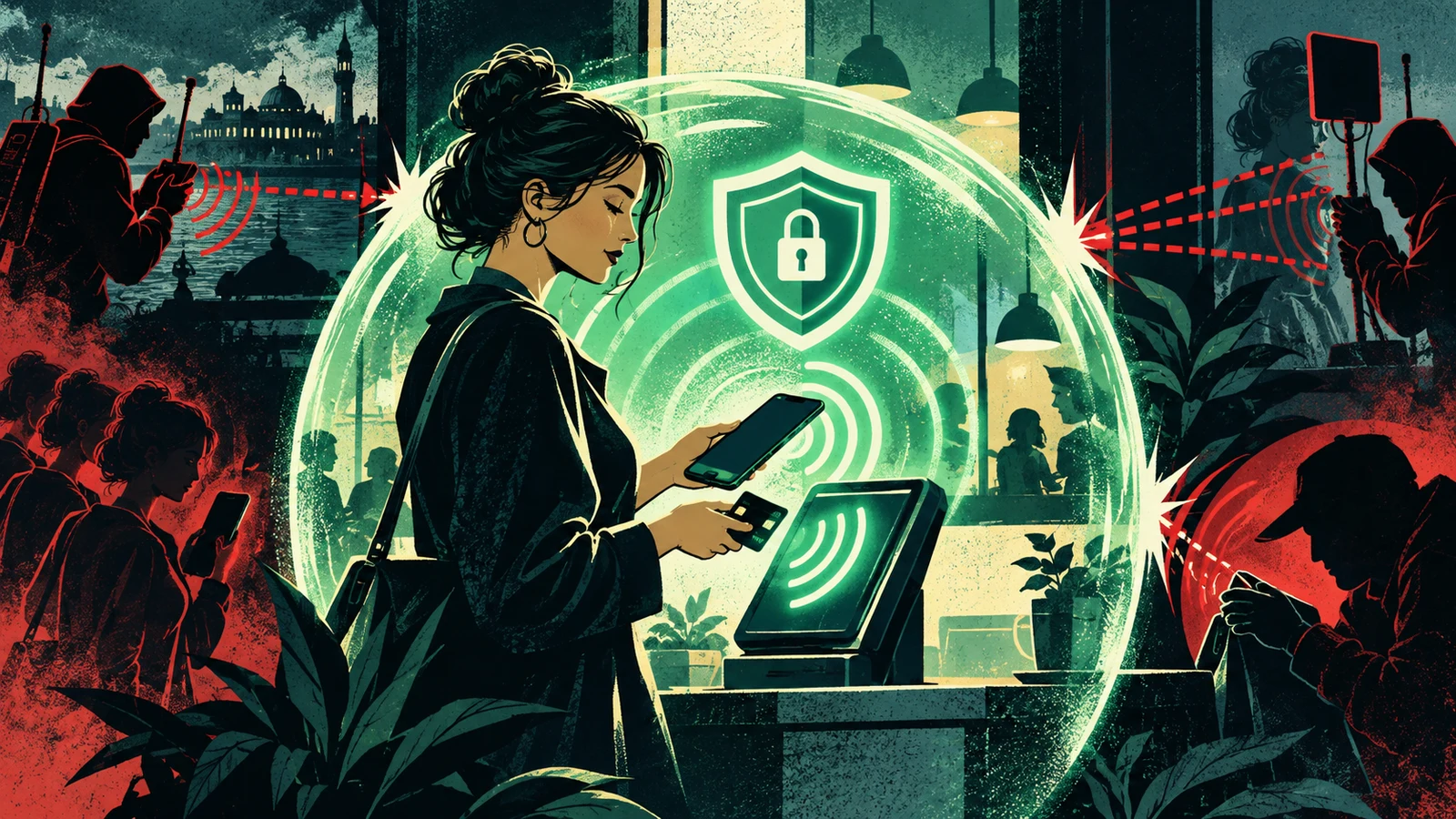
The setup uses two devices and two people working together. Call the first device the mole and the second the proxy. The mole is a reader held close to the victim's card, perhaps in a bag or a pocket on a crowded train. The proxy is a card emulator held against a genuine payment terminal somewhere else, which could be a shop across town or across a border. A fast data link, ordinary mobile internet is enough, connects the two.
Here is the sequence. The proxy taps the real terminal, which begins a transaction and sends the first protocol command. That command travels over the internet to the mole. The mole replays it into the victim's card. The card, believing it is talking to a normal terminal, computes its response, including a valid one-time cryptogram for that specific challenge. The response travels back to the proxy, which feeds it to the terminal. From the terminal's point of view, a legitimate card answered every challenge correctly, so the payment authorises. The card owner, meanwhile, felt nothing, because their card only had to be within a few centimetres of the mole for the fraction of a second the exchange took.
Two properties defeat the usual defences here. The one-time cryptogram, which stops replay, does not help, because the attacker is not replaying an old transaction, they are relaying a live one in real time. The short range, which stops remote reads, does not help either, because the attacker physically brought a reader to the card and moved the messages rather than the card. This is why the honest summary is that range protects against passive attacks and does nothing against an active relay.
The credible defence is timing. A genuine card sits centimetres from its terminal, so the round trip is near instant. A relay inserts an internet hop, which adds measurable delay. Some contactless protocols implement distance bounding, where the terminal measures how long the card takes to answer and rejects responses that arrive too late to have come from a card in the field. Where distance bounding is deployed, the relay's own latency becomes the thing that gives it away. The user-presence check on a phone wallet adds a second obstacle, because the emulated card on the proxy cannot satisfy a fingerprint prompt that the real phone never sees.
Detection signals
Most NFC risk is invisible to an ordinary user, but a few concrete signals are worth knowing, both for individuals and for the people who run access-control systems.
- Unexpected phone prompts on a tap. If tapping your phone near a surface offers to open a URL, add a contact, or join a network you did not initiate, you have met a programmed tag. Treat the offered action as untrusted and inspect any URL before acting on it.
- A payment that completes without your gesture. On a phone wallet, a charge should follow a deliberate unlock and tap. A transaction you did not authorise is a signal worth reporting to your bank immediately, and it is one reason to prefer wallets that require user presence over bare cards that answer any field.
- Access badges that stop being unique. For system operators, the telling signal of cloning is two uses of the same credential in places one person could not be at once, or a badge appearing at an odd hour that does not match the holder's pattern. Access logs that record card identifiers make this visible; systems that log nothing make cloning undetectable.
- Readers or overlays that look out of place. A relay or skimming setup needs hardware near the victim or the terminal. An extra reader taped near a legitimate one, or a device lingering unusually close to people's pockets in a queue, is the physical tell.
- Firmware and app versions behind on updates. The NFC stack that parses tag data is software. A device several versions behind on patches is more exposed to malformed-tag handling flaws, and version drift across a fleet is a measurable early-warning signal for the teams that manage phones.
The single most useful thing an access-control operator can do, short of replacing weak credentials, is log every read with a timestamp and a reader location. A static-identifier badge can always be copied, but a copy that is used leaves a trail: the same identifier appearing at two doors seconds apart, or at a time the holder is known to be elsewhere. Without logs, a clone is silent. With them, it becomes an anomaly you can investigate. This is the same detection logic used across physical security, and it costs almost nothing to enable.
NFC compared with its neighbours
It helps to place NFC against the other short-range and identification radios people confuse it with, because the differences drive the risk.
| Technology | Typical range | Powered tag | Main security concern |
|---|---|---|---|
| NFC (13.56 MHz) | A few centimetres | Passive, drawn from reader | Relay attacks, cloning weak cards, malicious tags |
| UHF RFID | Up to several metres | Passive, longer range | Remote reading and tracking of static identifiers |
| Low-frequency RFID (125 kHz) | Centimetres | Passive | Trivial cloning of old fobs, no real cryptography |
| Bluetooth Low Energy | Around ten metres | Active, battery | Pairing attacks, tracking, larger remote surface |
| Ultra-wideband | Several metres | Active, battery | Used for secure ranging, resists relay by design |
The pattern in the table is that range and power define the exposure. NFC's centimetre reach is what keeps its passive attack surface small, and its lack of a battery is why a lost or stolen tag cannot beacon to an attacker the way a Bluetooth device can. Ultra-wideband is worth noting because it was designed with secure ranging in mind, which is why some phone makers use it for car keys and precise unlock features that need to resist exactly the relay attack NFC struggles with.
Common misconceptions
A few beliefs about NFC are stubborn and wrong, and clearing them up sharpens the threat model.
"Someone can skim my card from across the room." The physics rules this out for the near-field band your card uses. A working read needs centimetres of proximity, so the across-the-room version belongs to UHF RFID, which your payment card does not use.
"An RFID-blocking wallet protects my money." For a modern payment card, the one-time cryptogram already makes a passive skim useless, so the sleeve blocks an attack that would not have produced a charge. The sleeve does more for a low-security static-identifier access badge, which is the credential actually worth shielding.
"Turning off NFC makes my phone safe." Disabling NFC removes the reader and tag attack surface, which is a real gain, but it does nothing for the many risks that arrive over the network, through apps, or via phishing. It is one lock on one door.
"My building badge is fine because it is contactless." Contactless says nothing about whether the card authenticates. Many deployed badges present a static identifier with broken or absent cryptography, which is easier to clone than a payment card. Contactless and secure are separate properties.
"Phone wallets are riskier than cards because phones get hacked." In practice the wallet credential lives in a hardened secure element, is tokenised, and usually requires a fingerprint or face check before it transacts, which makes it more resistant to relay and skimming than a bare card that answers any field it enters.
Frequently asked questions
Can an attacker charge my card just by bumping a reader against my bag? Against a modern contactless payment card, a passive read of this kind captures a one-time cryptogram that cannot be reused for a second charge, so the bump-and-skim scenario rarely becomes real fraud. The credible version of a close-proximity attack is a live relay, which needs a second person at a real terminal at the same moment.
Are phone wallets safer than physical cards? Generally yes. Wallet payments are tokenised, the credential sits in a secure element, and most require the phone to be unlocked with a biometric or passcode before it will transact. That user-presence gate is a real obstacle to relay attacks that a bare card, which answers automatically, does not have.
Should I buy an RFID-blocking wallet? For payment cards the benefit is marginal, because their per-transaction cryptograms already defeat passive skimming. If you carry a legacy access badge that presents a static identifier, a sleeve does more, since that identifier really can be copied. Spend the caution on the badge rather than the bank card.
How worried should I be about tapping random NFC tags? Treat unknown tags the way you treat unknown links. A programmed tag can push a URL or an action to your phone, which is a phishing vector. Your phone should ask before acting, so read what it offers and decline anything you did not expect.
Why are old office badges considered the real risk? Many still use schemes like MIFARE Classic, whose Crypto1 cipher was broken publicly years ago, or even simpler cards that just broadcast a fixed number. A cheap reader can copy such a badge in seconds of proximity, and a blank card can replay it. That is a far more practical attack than anything targeting a payment card.
Does disabling NFC hurt anything? Only convenience. You lose tap-to-pay and tap-to-share until you turn it back on. If you rarely use those features, leaving NFC off removes the reader and tag attack surface entirely, which is a reasonable trade for someone who wants to minimise exposure.
Can two phones be made to exchange data without the owners knowing? Peer-to-peer transfers require the devices to be almost touching and, on modern systems, usually need a confirmation on screen. The short range and the confirmation step make a silent exchange between two unwitting phones impractical in normal use.