Tangem Wallet Review: Security Model, Backup Cards and Trade-offs
A Tangem Wallet review from the security side: how the NFC cards generate and clone keys, what a lost or stolen card exposes, the seed phrase option, the 2024 app logging bug, Ledger Donjon's three Tangem attacks, prices, and how it compares with Ledger, Trezor and Keystone.
Tangem sells a hardware wallet the size of a bank card. There is no screen, no battery and no cable: you tap the card on your phone, the phone app builds the transaction, and the chip in the card signs it. By default there is no seed phrase either. Two or three identical cards hold copies of the same key, and the extra cards are your backup.
That design removes the most common way people lose self-custodied crypto, a recovery phrase that gets photographed, typed into a phishing site or thrown out. It adds trade-offs of its own, and this review is mostly about those. For how hardware wallets fit into a wider setup, start with our cryptocurrency security guide; for a roundup of wallets across types, see web3wagmi's best crypto wallets.
The verdict, up front
Rating: 3.9 / 5. Buy the 3-card Tangem set if you hold crypto long term, sign a handful of simple transfers a year, and would rather keep three cards in three places than guard a sheet of paper. Give it an access code of eight or more characters with a symbol, because the card's anti-guessing delay has a published $5,000 bypass. Buy a wallet with a screen if you interact with DeFi contracts, because a Tangem card signs whatever hash the phone gives it.
How Tangem works, step by step
1. Key generation on the chip. In the default seedless setup, the private key is created by the hardware random number generator inside the card's Samsung secure element, with entropy from the chip's physical sensors. Tangem's documentation states the key never leaves the chip in the clear, and that a new key is generated each time a card is reset to factory settings. The card ships with no key on it, so nobody at the factory has seen yours.
2. Cloning to the backup cards. During setup you scan the backup cards one after another. The cards authenticate each other, agree a 256-bit key with Diffie-Hellman, and the key travels card to card encrypted so the phone app cannot read it. There is no primary card: every card in the set has equal, full access to one wallet.
3. Backup happens once. You can clone a key only at setup. Tangem's reason: the cards do not know about each other and do not call home, so if backups could be added later, someone holding one of your cards could quietly mint extra copies. A 2-card buyer therefore cannot add a third card later.
4. The access code. One access code protects every card in the set, and you can later give each card its own. After six wrong attempts each further attempt waits one second longer than the last, up to a maximum of 45 seconds (reached around the 51st try), and the delay resets only after a correct entry. Forgetting the code is recoverable: you reset it with the card plus one backup card to confirm. With only one card left, it cannot be reset.
5. Signing. When you send funds, the app builds the transaction, hashes it and asks you to tap the card. The card checks the access code and signs the hashes. Tangem's own SDK describes the operation as "Signs transaction hashes using a wallet private key, stored on the card." The card never sees the transaction in readable form.
6. Authenticity checks. Every chip carries a Tangem key pair, and the app verifies that Tangem made the chip and that it runs Tangem firmware before any wallet operation. A new card prompts you to create a wallet. A card that says it is already activated, or asks for a code you never set, has been used before and should be reset.
The security model
The chip and what EAL6+ covers
Tangem names the chip as a Samsung S3D350A certified to Common Criteria EAL6+. Ledger's researchers, who opened a card in 2026, identified the part as an S3D232A. Both are in the same Samsung family, whose current certificate is ANSSI-CC-2024/15: EAL6+ augmented, evaluated by CEA-LETI for France's ANSSI, valid from May 2024 to May 2029. Cards made before May 2024 were built under the family's earlier certificates.
The certificate covers the chip, its random number generator and Samsung's crypto library. Tangem's wallet code, which runs on top, is outside it. That code is what the audits looked at.
Audits
| Audit | Year | Scope | Published result |
|---|---|---|---|
| Kudelski Security | 2018 | Source code of the card firmware. Physical attacks were out of scope | Risks found and mitigated, no backdoors; full report not published; a fingerprint of firmware v1.28 recorded so apps can verify it |
| Riscure | 2023 | Card firmware, NFC command interface, side-channel mitigations | No exploitable backdoors, per Tangem's summary |
| Cure53 | Tested November 2025, summary dated 10 February 2026 | Android and iOS SDKs: white-box code audit, penetration test, cryptography review | 12 findings, none critical or high. Tangem fixed the 3 vulnerabilities and 7 lesser findings; 2 were accepted as low impact |
None of the three audits caught the card attacks Donjon later published, and the Cure53 work covered only the phone SDKs.
Closed, frozen firmware
The firmware is written to the chip once and can never be updated. A malicious or coerced update cannot reach your card, which is a real advantage over wallets that take firmware updates. A flaw found later can also never be fixed on cards already sold, and two such flaws were published in 2025 and 2026.
The firmware source is not public. Tangem's help centre calls this a "security through obscurity" approach and points to the audits as the substitute. The phone app and SDK code is on GitHub under a licence that states "THIS IS NOT AN OPEN SOURCE LICENSE". It grants a revocable right to read the code, audit it and build it for your own device, forbids redistribution and commercial use, and in Section 4 forbids recreating the card protocol for other apps. That is enough to check what the app does with your keys. As a plan for the day Tangem disappears, it is thin.
No screen
A screen wallet shows you the recipient and amount on hardware the attacker does not control. Tangem shows them on your phone. If the phone or the app is compromised, it can display one transaction and pass the card the hash of another, and the card has no way to notice. For simple sends to an address you have checked, that risk is small. For DeFi approvals and contract calls, where the readable intent is buried in calldata, it is the same exposure our blind signing guide describes, with no second screen to catch it.
Ledger Donjon's three Tangem findings
Ledger's security lab published three attacks on Tangem between May 2025 and July 2026. Ledger sells a competing wallet, so read the claims with that in mind; the technical details are public and Tangem's responses are on record.
Android genuine-check bypass (published 15 May 2025). The Android app ran two checks to confirm a card was genuine and used only the result of the second, so a counterfeit card could pass. Donjon reported it on 27 November 2024 and Tangem fixed it the next day in Android app 5.18.3, then paid a $15,000 bounty. Keep the app updated and buy cards from Tangem or a listed reseller.
Guessing-delay bypass (published 17 September 2025). The card uses a secure channel feature that the Tangem app never calls. By cutting power to the card at a precise moment (a "tearing" attack) during that channel's handshake, Donjon learned whether a guessed code was right before the card recorded a failure, so the delay never kicked in. The rate was about 2.5 guesses per second, the setup cost under $5,000, and the attacker needs the card in hand. It cannot be patched on existing cards. Tangem told Donjon the issues do not qualify as vulnerabilities and that the scenario does not pose a significant risk. Donjon recommends an access code of at least eight characters with at least one digit, one letter and one symbol.
Laser access-code reset (disclosed to Tangem 10 February 2026, published 9 July 2026). A single laser pulse on the exposed chip skips a check in the access code handler, letting the attacker set a new code without the old one and without a backup card. From there they can sign any transaction. Donjon's bench cost about $250,000; once the chip was characterised, each card took about 2 hours with a 100% success rate in their tests. The card is cut open in the process, so it cannot be returned to you unnoticed. Tangem's setting that disables access code recovery does not stop it, and it affects every card in circulation. Tangem's public line, per The Block, is that the risk to everyday users is "virtually non-existent".
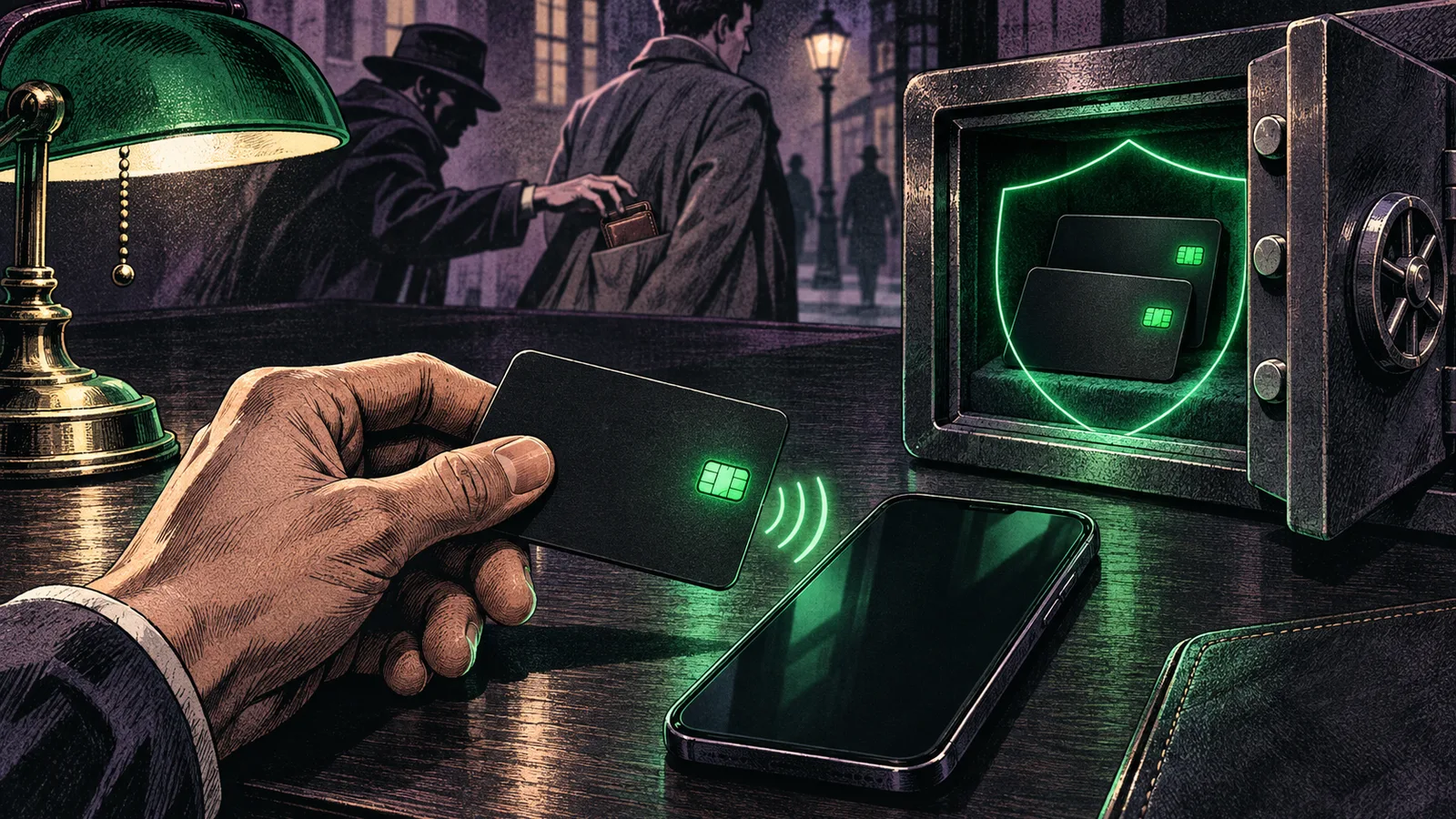
Worked example: a 3-card set, one card lost, one stolen
You set up a 3-card wallet without a seed phrase. Card A is in your wallet, card B in a drawer at home, card C at a relative's house. The access code is k7Rw2q.
Card A falls out in a taxi. You still have B and C, so you keep full access. Whoever finds A has a valid key to your wallet behind your access code, and you cannot revoke it. The correct response is to buy a new set and move the funds. Until then, the finder's chances depend on the code.
Card B is stolen in a burglary. The burglar has one card and no backup card, so they cannot use the access code reset. They can only guess. The time to try every code:
| Access code | Possible codes | Worst case, card's delay (45 s per try) | Worst case, Donjon bypass (2.5 tries/s) |
|---|---|---|---|
A birthday such as 140592 | A handful if your birth date is known; about 36,500 dates if not | Seconds if known; about 19 days if not | Seconds if known; about 4 hours if not |
| Random 6 digits | 1,000,000 | About 520 days | About 4.6 days |
Random 6 letters and digits, mixed case (k7Rw2q) | About 56.8 billion | About 81,000 years | About 720 years |
| Random 8 characters with symbols (95 printable characters) | About 6.6 quadrillion | Billions of years | About 84 million years |
The average is half the worst case. Human-chosen codes fall faster: Donjon estimates one million common passwords take about 4.5 days with the bypass. k7Rw2q holds against a $5,000 rig for centuries, and a burglar without that rig gets nowhere, but a six-digit code does not survive a week.
A lab attacker gets card B. With the $250,000 laser setup the code length stops mattering: they reset it and sign. For a burglar this changes nothing. For a target worth that equipment and expertise, a stolen card should be treated as compromised.
What you have left. Card C, plus the new set you are about to buy. Had you bought the 2-card set, losing A and B would have left you with nothing.
The same story in seed phrase mode. Everything above still applies, plus two changes. If A, B and C were all gone, you could import the phrase into a new Tangem set or any BIP39 wallet. And there is now a fourth copy of your keys on paper, and whoever finds it needs no card and no access code at all.
Seed phrase mode, and the December 2024 incident
Since its second-generation cards, Tangem offers a seed phrase as an option during setup. In that mode the app, on your phone, picks 12 or 24 words from the BIP39 list, derives the keys and loads them into the cards. You can also import an existing phrase of 12, 15, 18, 21 or 24 words, with an optional passphrase. The phrase is not stored on the cards or in the app afterwards.
The weak moment is creation, when the phrase exists in the phone app. In December 2024 users found that the app had been writing private keys into its own logs when a seed-phrase wallet was created. The logs went to Tangem support as email attachments if the user sent a support request through the app within seven days of activation. Tangem said fewer than 0.1% of users were potentially affected, shipped a fix on 30 December 2024, deleted the logs and attachments it held, and said no funds were lost. Tangem's deletion does not reach the copy in the user's own sent mail. If you sent a support request from the app in your first week on a seed-phrase wallet before that fix, treat the keys as exposed and move the funds to a new wallet. Seedless wallets were unaffected, because their keys never pass through the app.
Seed phrase mode makes Tangem an ordinary BIP39 wallet with a card-shaped signer, and you inherit every seed phrase risk. If you choose it, generate the wallet on a freshly updated app, never contact support from the app with that phone in the first week, and store the phrase the way you would for any other wallet.
Supported chains
Tangem lists more than 87 blockchain networks and over 16,000 coins and tokens, including Bitcoin, Ethereum and its layer 2s, Solana, TON, TRON, XRP Ledger, Cardano, Polkadot and Litecoin. dApps connect through WalletConnect in the app. Coverage is broad enough that it is rarely the reason to pick another wallet.
Price
| Set | Price on tangem.com |
|---|---|
| 2 cards | $54.90 |
| 3 cards | $69.90 |
| Family Pack (two 3-card sets) | $139.80 |
| Tangem Ring with 2 cards | $160.00 |
| Pro Kit | $180.00 |
List prices checked 23 November 2026. Our referral code IMPTG10 takes 10% off at checkout. Tangem's pricing page also runs its own offers, such as a code emailed to new subscribers, which are sometimes larger, so compare before you pay. A third card costs $15, and backups cannot be added later.
Tangem vs Ledger, Trezor and Keystone
Entry models from each brand, prices from each brand's own store. All three competitors were on Black Friday sale when we checked in late November 2026, so expect their prices to rise afterwards.
| Tangem, 3 cards | Ledger Nano S Plus | Trezor Safe 3 | Keystone 3 Pro | |
|---|---|---|---|---|
| Price | $69.90 list | On sale at $62 in late November 2026 | On sale at $39 in late November 2026 | On sale at $149 in late November 2026 |
| Screen | None, uses the phone | 1.1 inch mono OLED | 128 x 64 mono | 4 inch touchscreen |
| Secure element | Samsung, CC EAL6+ | ST33K1M5, CC EAL6+ | CC EAL6+ | Three secure elements, no CC level on the product page |
| Firmware source | Closed card firmware, source-available app | Apps open, secure element OS partly closed under Ledger's agreement with STMicroelectronics | Open source | Published as open source |
| Seed handling | None by default; optional BIP39 | BIP39 recovery phrase | 12, 20 or 24 words, or multi-share | BIP39 recovery phrase |
| Connection | NFC | USB | USB | QR codes, air-gapped |
| Firmware updates | Never | Yes | Yes | Yes |
Tangem is the only one with no phrase by default and no screen. Trezor and Keystone let you read the firmware; Tangem and Ledger ask you to trust audits. Every screen wallet here can show you a transaction on hardware your phone cannot tamper with.
Who Tangem suits
Good fit:
- Long-term holders who buy, send rarely, and want the key in certified hardware.
- People who would lose, photograph or mistype a seed phrase, including relatives you are setting up, provided someone helps them pick a long access code.
- Anyone who wants a backup they can split across locations without paper, steel plates or Shamir shares.
Poor fit:
- Active DeFi users approving contract calls. Read the DeFi security guide and buy a wallet with a screen.
- Anyone whose phone is the weakest device they own. The phone is part of Tangem's trust chain.
- People who require fully open firmware, or a fix path for flaws found later.
Two notes on what Tangem does not cover. Funds left on an exchange are outside any hardware wallet; the crypto exchange security guide covers that account. And a Tangem card is not a login key: protecting your exchange and email accounts is the job of a FIDO2 key from our hardware security keys roundup.
Bottom line
Keys are born on a certified chip, copied once over an encrypted channel, and never shown to anyone, including you. The cost is a signer with no screen, firmware nobody outside the auditors can read or fix, cards that stay valid keys until you move the funds, and two published card attacks that will never be patched. The rating drops from where the design alone would put it because the cheaper of those attacks makes short access codes weak. Buy the three-card set, set an access code of eight or more characters with a symbol, keep the cards apart, skip seed phrase mode unless you need it, and keep complex DeFi signing on a device that can show you what it signs.
Sources & further reading
- Tangem pricing (Tangem)
- Private Key Security (Tangem)
- How Backup Works (Tangem)
- All About Access Code (Tangem)
- Firmware & Authenticity (Tangem)
- How to Set Up With a Seed Phrase (Tangem)
- How to Import a Wallet With a Seed Phrase (Tangem)
- Security audits (Tangem)
- How Many Cryptocurrencies Does Tangem Support in 2026? (Tangem)
- Tangem Announces Second Successful Hardware Wallet Audit (Tangem)
- Audit of Tangem's smartcard wallet code (Kudelski Security)
- Independent Security Audit of the Tangem Mobile Wallet (Q4 2025) (Cure53)
- S3D350A family Common Criteria certificate ANSSI-CC-2024/15 (sec-certs.org)
- Tangem Genuine Check Bypass on Android Application (Ledger Donjon)
- The Vulnerability Exposing Tangem Cards to Brute-Force Attacks (Ledger Donjon)
- Bypassing Tangem Card Security with a Laser Attack (Ledger Donjon)
- Ledger researchers disclose Tangem card flaw; Tangem says risk to everyday users is virtually non-existent (The Block)
- Tangem fixes bug exposing user seed phrases via email (Cointelegraph)
- tangem-app-ios licence (Tangem on GitHub)
- Tangem SDK SignCommand (Tangem on GitHub)
- Ledger hardware wallets comparison (Ledger)
- Ledger Nano S Plus (Ledger)
- Is Ledger open source? (Ledger)
- Trezor Safe 3 (Trezor)
- Compare Trezor models (Trezor)
- Keystone 3 Pro (Keystone)
Related guides
- Blind Signing: How Crypto Signers Approve Transactions They Cannot Read
What blind signing is, how attackers used it to take Bybit, Radiant and WazirX, and how to check a transaction hash yourself before you sign.
- Crypto Exchange Security: Protecting Your Account
How centralized exchange accounts get compromised: SIM swaps, API key theft, phishing and insider threats, plus a security checklist to protect your holdings.
- Blockchain Privacy: What's Actually Anonymous
Bitcoin is pseudonymous rather than anonymous. How chain analysis works, what privacy coins do, the law around mixers, and how police trace crypto.