Colonial Pipeline: One Legacy VPN Account Without MFA
How the May 2021 Colonial Pipeline ransomware incident happened: a dormant VPN account with a reused password and no MFA, the decision to shut the pipeline, the ransom, and the partial recovery.
The largest refined fuel pipeline in the United States stopped for five days because of a password.
Not a sophisticated exploit chain, not a zero-day, not a supply chain compromise. A VPN account that nobody used any more, whose password had appeared in a leak from some other website, with no second factor in front of it.
What makes the case instructive is less the intrusion than everything after it: the decision to shut the pipeline under uncertainty, the payment that did not deliver fast recovery, and how quickly an IT incident at a private company became a national fuel story.
Timeline
| Date | Event |
|---|---|
| 29 April 2021 | A DarkSide affiliate logs into the VPN appliance with a legacy profile and a valid employee password. Mandiant found no attacker activity before this date |
| 6 May 2021 | Roughly 100 gigabytes of data is exfiltrated over about two hours |
| 7 May 2021 | Ransomware is deployed on IT systems. Colonial shuts the pipeline as a precaution and the chief executive authorises the ransom |
| 8 May 2021 | The 75 bitcoin payment reaches the attackers, per the FBI seizure affidavit. The FBI publicly attributes the incident to DarkSide ransomware on 10 May |
| 8 to 11 May 2021 | Panic buying spreads across the southeastern US. Fuel stations run dry |
| 12 May 2021 | The pipeline restarts. Normal delivery takes several more days |
| 7 June 2021 | The Department of Justice announces recovery of approximately 63.7 bitcoin |
| Late May and July 2021 | TSA issues security directives for pipeline operators |
The way in
The account was a legacy VPN profile: still valid, no longer in use, and not protected by multi-factor authentication. Mandiant found the same password in a batch of leaked credentials circulating online, which points to reuse on some other service rather than to any compromise of Colonial itself. Charles Carmakal of Mandiant told Congress the password was reasonably complex and unlikely to have been guessed, and that an exhaustive search found no phishing of that employee and no attacker activity before 29 April.
Three ordinary failures, stacked:
A dormant account that still worked. Nobody used it, which also means nobody would have noticed it being used. Accounts that survive their purpose are the most attractive credentials in any estate: full access, zero attention. The control is joiner-mover-leaver process and a periodic review that disables anything not authenticated in ninety days.
Password reuse. The same password somewhere else, breached there, sold in bulk, and tried here. What Is an Infostealer covers the modern version of this supply chain, and Password Managers Guide covers the individual fix.
No multi-factor authentication on remote access. One control, applied to that one account, ends this incident before it starts.
There is no fourth failure required. That is the entire initial access story for an incident that made international news. Eight days passed between that first login on 29 April and the ransomware on 7 May, which is time an alert on a dormant account authenticating would have bought.
Credentials are one of two ways into a remote-access edge. The other is the appliance itself, and the VPN edge CVE watch lists every Fortinet, Ivanti, Cisco ASA, SonicWall, Citrix and Palo Alto entry in the CISA Known Exploited Vulnerabilities catalogue, with the EPSS score, the ransomware linkage and the federal remediation deadline on each row. If you run one of those boxes, it tells you which of your models has a confirmed in-the-wild exploit and how urgent the patch is.
The shutdown decision
The ransomware ran on business systems. The pipeline's operational technology, the industrial control systems that actually move fuel, was not reported as encrypted.
Colonial stopped the pipeline anyway, for two reasons that are worth separating.
Uncertainty about the boundary. With attackers on the IT network and no way to immediately prove the OT network was untouched, continuing to operate meant betting on a separation the company could not yet verify. Stopping was the conservative choice under incomplete information, and it was the right one.
The business could not function. Billing, scheduling and allocation systems ran on the affected IT side. Fuel can move without invoices for a while, and not indefinitely.
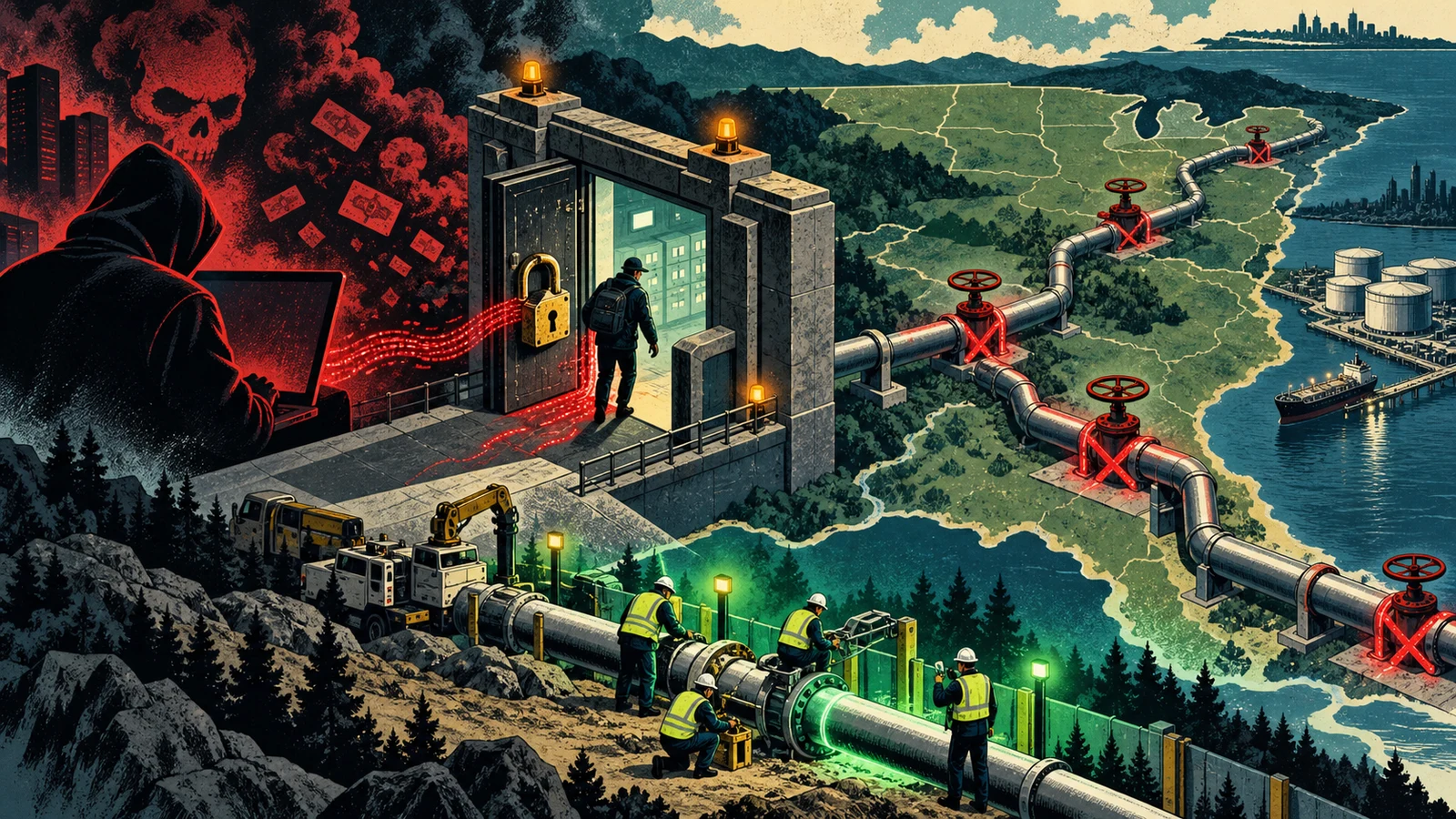
The uncomfortable question this raises for anyone with an OT environment is whether you could answer, on the day, how well separated the two are. Most organisations cannot, because the separation is documented rather than tested, and there are usually more crossings than the diagram shows: a historian server pulling process data into a business database, an engineering workstation with dual connections, a vendor remote-support path, a shared directory for authentication. Network Segmentation Guide covers verifying a boundary rather than declaring one.
The payment
Colonial paid 75 bitcoin, roughly 4.4 million dollars, quickly.
The chief executive's public explanation was uncertainty: it was not clear how long restoration would take, and the consequences of a long fuel supply interruption were severe enough to justify buying an option on faster recovery.
The option did not pay out well. Reporting and testimony indicate the supplied decryption tool was slow enough that the company relied heavily on its own backups. This is the common experience, and it belongs in any pre-incident discussion about payment: decryptors are written by criminals to a standard that does not include performance, they frequently fail on some file types, and restoring from your own tested backups is usually faster. 3-2-1 Backup Strategy covers making sure that option exists.
The recovery of about 63.7 bitcoin by the Department of Justice was a genuine surprise and should not be treated as a repeatable outcome. That was the affiliate's share of the payment, and bitcoin had fallen far enough by 7 June that it was worth about 2.3 million dollars when it was seized, against the 4.4 million paid a month earlier. It depended on specifics of how the funds were held, and most payments are not recovered.
The public consequences
The pipeline was down for about five days. Fuel shortages across the southeastern United States were driven mostly by panic buying: coverage of a pipeline shutdown produced demand far above normal, stations ran dry, and images of empty pumps drove more of the same.
That dynamic deserves a place in incident planning. The second-order public reaction can exceed the direct operational impact, and it is influenced by communication. Organisations running services the public depends on need a communications plan that assumes the story will move faster than the facts.
Regulation followed almost immediately. The TSA issued security directives for pipeline owners and operators requiring reporting of incidents to CISA, a named cybersecurity coordinator, and subsequently specific mitigation measures and testing. A sector that had operated under voluntary guidance was under enforceable direction within weeks, which is the pattern after any incident with visible public consequences.
What generalises
- Disable accounts when they stop being needed. Dormant, valid credentials are the cleanest way into any network.
- MFA on every remote access path, without exception for legacy profiles. The exceptions are the attack surface.
- Know whether your IT and OT separation is real, because you will be asked during an incident and the answer determines whether you can keep operating.
- Payment is not a recovery plan. Decryptors are slow and unreliable, and the decision is better made in advance with legal and executive input than at 3am.
- Plan the public communications for an incident that affects people outside your organisation.
The verdict
A single unused VPN account with a reused password and no second factor stopped a pipeline that carries a large share of the fuel for the eastern United States.
The technical lesson is small enough to act on today: find the accounts nobody uses, disable them, and put multi-factor authentication on everything that grants remote access. The organisational lesson is larger, and it is that the decisions which determined the impact were made under uncertainty about network boundaries that nobody had verified in advance.
Related guides
Sources & further reading
- Testimony of Charles Carmakal, Mandiant, before the House Committee on Homeland Security (US House Committee on Homeland Security)
- Department of Justice Seizes $2.3 Million in Cryptocurrency Paid to the Ransomware Extortionists Darkside (US Department of Justice)
- DarkSide Ransomware: Best Practices for Preventing Business Disruption from Ransomware Attacks (CISA and FBI)
- Security Directive Pipeline-2021-01 (US Transportation Security Administration)
- Justice Dept. Claws Back $2.3M Paid by Colonial Pipeline to Ransomware Gang (KrebsOnSecurity)
- #StopRansomware Guide (CISA)